
When forming strategies, focus less on the enemy’s army, but on the mind of the one who leads it. When you have a good grasp of what makes them tick, you will be able to anticipate their next moves.
To do this, make sure to train yourself to have a good read of people and invest in gaining intelligence on your opponent. But beware of projecting your own cultural notions and emotions – this is what led to British failure in Afghanistan.
Rather, probe for their weaknesses, and try to access their innermost thoughts.
The Worst Possible Retreat
During the middle of 1838, the British governor-general of India, Lord Auckland, met with his advisors and officials to review a potential invasion of Afghanistan. The British had been growing increasingly worried about a potential Russian incursion as well as its growing influence in the area.
The Russians had already won over the Persians and were now attempting to do the same with the Afghan ruler, Dost Mahomed. The British were not going to take their chances by also negotiating with him.
Instead, they contacted the former ruler of Afghanistan, Shah Shuja, who had been deposed over twenty years earlier and proposed reinstalling and aligning with him. This seemingly surer solution would see Afghanistan ruled by a man both indebted to the British, and more likely to acquiesce to their dictates.
Among those present at the meeting was William Macnaghten, the chief secretary of Calcutta. He thought this was a wonderful idea: taking control of Afghanistan would expand British influence where it had never reached before; and how could it fail – they would sweep aside the primitive tribal fighters easily.
Not only would they present themselves as liberators freeing the Afghans from the grasping hand of the Russians, but they would also quickly leave once they had completed their task. The ruler would be controlled by Britain, but that influence would be invisible to the Afghan public.
Macnaghten’s enthusiasm was so palpable that Auckland named him the queen’s envoy to the Afghan capital, Kabul. Thus he became the top British representative in Afghanistan.
By August 1839, Dost Mahomed had fled, and the shah re-entered Kabul with the British army after meeting little resistance. As they entered the public was met with a curious sight – they saw the shah as old and frail and looking submissive next to Macnaghten who was wearing bright clothes and a pretentious ostrich feather on his cocked hat.
Who were these people, and why had they come?
Once in charge, Macnaghten began to assess the situation he was now presented with. Reports suggesting that Dost Mahomed was building an army in the north were flowing in, as well others informing him that to the south, chieftains, who had been insulted by British expropriation of their resources, were causing trouble.
To compound the myriad problems, the shah was proving extremely unpopular with his former subjects; Macnaghten, therefore, decided he could not leave the him (as well as British interests) unprotected. Thus he ordered that the withdrawal would be delayed until stability returned.
Some time went by, and Macnaghten finally gave into requests for the soldiers to send for their wives and children. But rather than having a civilizing effect on the soldiers, it led to the locals fearing that the British were to stay for good.
Everywhere they looked they saw the British influence: British people were attending horse races, taking loudly in the streets, drinking wine in a Muslim land, and a plethora of other imported pleasures. As is the case with human nature, wherever they looked, they saw red, and soon a deep hatred took hold.
There were those who had cautioned Macnaghten about this. His response was always the same: the Afghans would acclimate themselves with these changes, that once they tasted the benefits of British civilisation, they would welcome them with open arms, and that in any case, the army would soon be leaving.
What worried him was not how the barbaric Afghans were taking the occupation, but the demands of the British government to reign in this increasingly expensive expedition. Fortunately, Macnaghten knew exactly where he should begin balancing the books.
Afghanistan, being a mountainous land, had mountain passes which needed to be kept open to let trade and passing armies through. These passes were run by the Ghilzye tribes who were traditionally paid to keep these passes open – it was this money Macnaghten set his eyes upon.
He cut the stipend in half and then was surprised when the Ghilzye closed the passes and started a rebellion with other tribes against the British. The British were going to have to stay much longer now.
From there things went south very quickly – a British official was killed, and chieftains in Kabul began conspiring against the shah. Shah Shuja petitioned Macnaghten to allow him to round up and execute his main political enemies (a traditional method of securing power), but the Queen’s envoy would not allow him.
This was “uncivilized”, he was told, and a truly civilised country does not resort to murder. The shah, however, understood something Macnaghten failed to appreciate – that, in Afghan society, this would make him seem weak and allow the sharks to surround him.
In short order, the rebellion spread all over Afghanistan. But Macnaghten did not panic, for, after all, the Afghan’s were naïve, and he would muster all his guile and cunning to get through this.
He began to publicly announce that he wished to negotiate an agreement whereby the British would leave, and the Afghans would provide the food and resources necessary for their retreat. In private, he promised a number of chieftains that he would make them the country’s vizier and open up the British treasury to them – so long as they could put down the rebellion and allow the English to stay.
His offer was answered by the Akbar Khan, chief of the eastern Ghilzye (and Dost Mahomed’s son). He met with Macnaghten in an open area, and asked if he was prepared to go through with the treachery.
Thrilled at his own genius, he replied positively. Without warning, Abkar gave a signal, Macnaghten was seized and sent on his way to prison.
Apparently, Akbar was not interested in betraying his peers. Macnaghten’s troubles unfortunately did not end there: a mob had been developing as this went on, and they managed to get hold of Macnaghten in the commotion.
To cut a long story short, they quite literally tore Macnaghten apart, paraded his head around, and hung his torso from a meat hook in the bazaar.
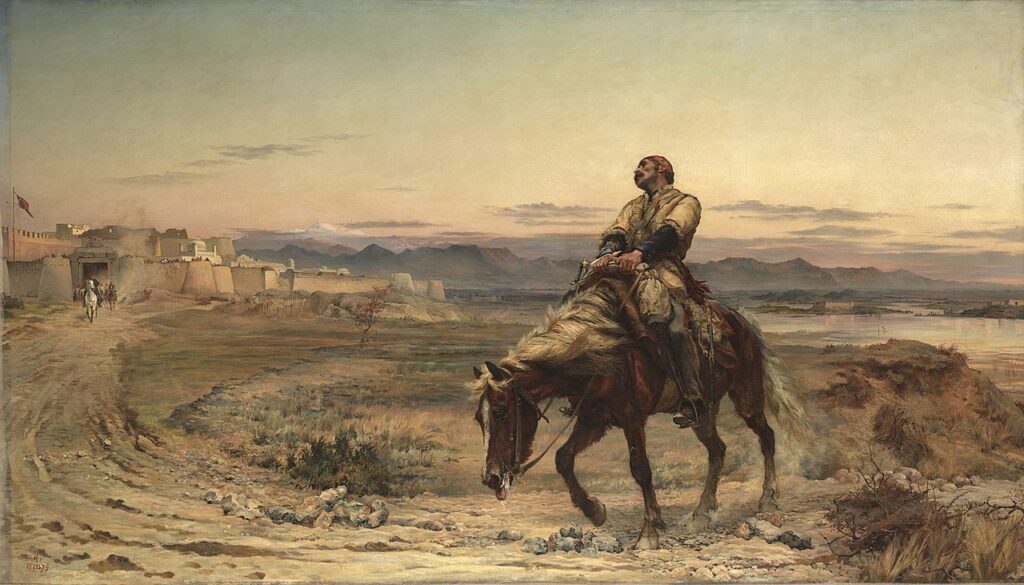
For the rest of the British, it took just a few days for the situation to unravel. 4,500 soldiers and about 12,000 followers (civilians included) were forced to retreat by the Afghans. The Afghans had promised to provide for them along the way, but soon they reneged from fear of more British treachery.
Instead, they constantly harassed the army as the passed through the country, and along the way both humans and horses perished alike. On January 13 1842, a single rider, Dr William Brydon, rode half-dead into the British garrison at Jalalabad.
On asked where the rest of the army was, he replied, “I am the army!”
Analysis of the Afghanistan Campaign
This dramatic episode could have been averted had Macnaghten taken the time to understand his enemy a little. Nor did he have the excuse of lack of information – he was stationed in India at the time, and there were a plethora of people who had visited Afghanistan that could have informed him.
Had he enquired, he would have found that the Afghans were some of the proudest people on the face of the earth; a people who saw foreign troops marching across their land as a humiliation; a people who did not yearn for peace and reconciliation; a people who saw conflict as a healthy way of life.
Macnaghten had all the information he needed but he did not use it. He projected English values onto the Afghans, he was blinded by narcissism (and racism), he failed to do the dirty work necessary to secure his position, he kept up the occupation of Kabul despite public opposition and halved the Ghilzye stipend.
It seemed that at every step of the way, he made the incorrect strategic move. And his last failure, which involved him attempting to bribe the very people he had humiliated so severely, caused him to lose his head.
Footnotes & Further Reading
Greene, Robert. The 33 Strategies of War. Millionaire, 2006