It is always wise to look at the world through the eyes of other people. This especially applies to your enemy before engaging in war.
Often you will find that your own cultural prejudices are a hindrance to seeing a situation clearly. Nor is this a matter of political correctness or faux sensitivity – it is the difference between good strategy and bad strategy.
The North Vietnamese, during the Vietnam War, painstakingly analysed and studied American cultural norms, the social effects of the newly invented television, and the general shifts in U.S. public opinion. The Americans, on the other hand, scorned understanding the Vietnamese.
Thus they failed to both effectively support the South Vietnamese they were backing and fight the North Vietnamese. Due to their preoccupation with stopping the spread of communism, the failed to take note of the influences behind the North Vietnamese way of thinking.
And so was born the awful strategy that lost them the war…
Losing the Vietnam War
By 1967, US military leaders in Vietnam believed they were finally making headway. After launching a series of search-and-destroy operations against the North Vietnamese, they had taken control over much of the countryside.
Yes, the guerrilla fighters were still eluding them, but the Americans had inflicted on them many losses. Also, the South Vietnamese government was stabilizing which could help win over the Vietnamese public.
In North Vietnam’s territory itself, bombing operations had crippled the enemy air force. Back home in America, despite the protests, polls showed that the public still supported the war effort and that they thought the end was at last in sight.
Up until this point the North Vietnamese had not done very well in direct face-to-face combat – the might of American firepower and technology was simply too great. Yet American generals were sure that the war could not be won without a battle, so the strategy was to somehow lure them into one decisive battle.
By the end of the year, it seemed that the enemy had finally taken the bait. Intelligence reports suggested North Vietnamese general Vo Nguyen Giap was planning an offensive against the US marine outpost of Khe Sanh in what was apparently to be a repeat of Dien Bien Phu, the 1954 battle which finally kicked the French out of Vietnam.
Khe Shan served a number of strategic purposes. Firstly, it was just 14 miles from the demilitarized zone separating the North and South.
It was also just 6 miles from the Laotian border, which was the site of the Ho Chi Minh Trail, the legendary supply route which brought provisions from North to South Vietnam. From Khe Sahn, the US supreme commander William Westmoreland was able to monitor movements to the North and West.
Dien Bien Phu played a similar role for the French, but unlike the French, Westmoreland was certainly not going to tolerate losing it. He fortified the area and built well-defended airstrips in the vicinity to make full use of his helicopters.
He also ordered substantial amounts of troops from the South to reinforce the site, along with around 6,000 marines. That being said, he certainly did not want to discourage an attack on Khe Sahn; far from it, he wanted this to be their death knell.
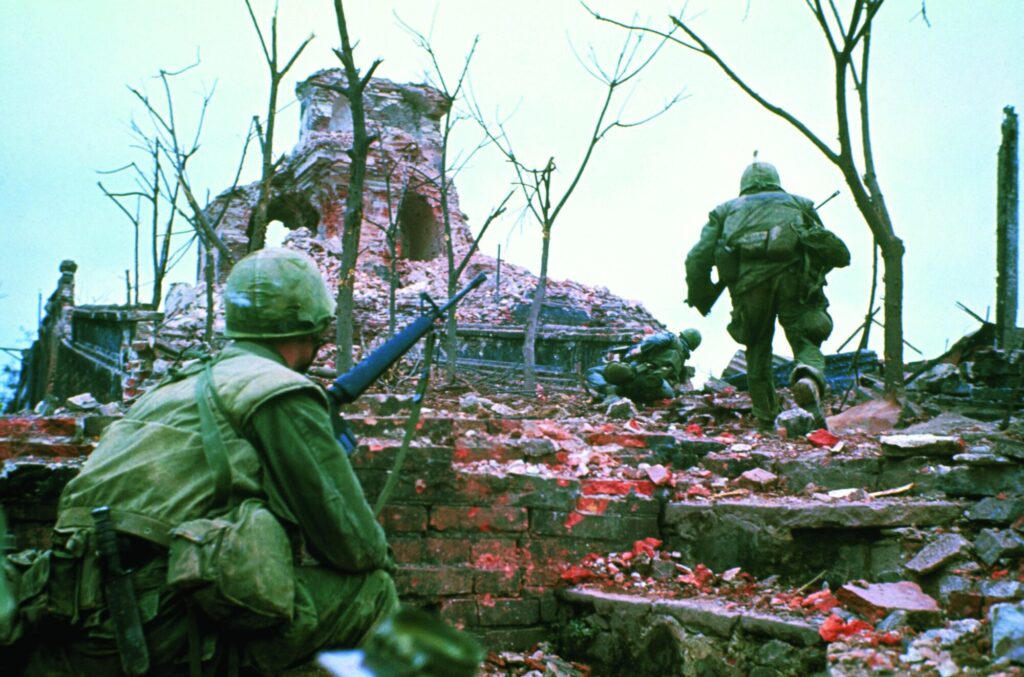
The first few days of 1968 saw all eyes on Khe Sanh; the White House, the American media, the American public – all were focused. And they were right to be focused, as on January 21 1968, the North began their ferocious attack in earnest.
Shortly after the battle began, the North Vietnamese and the Americans agreed to halt fighting during observance of the lunar new year, the Tet, during which it was tradition to cease fighting. However, soon after the truce, reports began to trickle in that the North Vietnamese had launched attacks all over South Vietnam.
So widespread was the attacks that almost every major town and city came under attack – one general studying the assault pattern on a map said it “resembled a pin ball machine, lighting up with each raid.”
Even the capital Saigon descended into chaos. Not only was the wall of the US embassy blown through by enemy soldiers, the presidential palace, the city’s radio station, and even Westmoreland’s own compound were attacked.
And let’s not forget that as this was taking place, street fighting and all, everything was being broadcast to the American public via television. And not only in Saigon.
Most prominent of all the cities captured was the ancient Vietnamese capital of Hue, a city revered by Buddhists, which was fully captured by the Vietcong (northern insurgents which had infiltrated the south).
In the meantime the attacks on Khe Sanh continued on unabated. In the eyes of the American military, it was extremely hard to discern whether these attacks were aimed at drawing forces away from Khe Sanh, or the other way around?
In any case, the Americans soon regained control, and though the sieges at Hue and Khe Sanh took longer, American artillery and bombardments overcame the insurgents.
Once the Tet Offensive was over, Westmoreland positioned it as a huge win for the Americans. He compared it favourably to the Battle of the Bulge from WWII which saw the Nazis launch a surprise attack against the allies; though the Germans did well in the beginning, it became clear after the allies recovered that it was effectively their final death throes.
So it was for the North Vietnamese as well – the Vietcong infrastructure was wiped out and the enemy had suffered terrible loses. They would never be able to recover from this terrible defeat.
While the US military in Vietnam celebrated the Vietcong’s tactical disaster, reports started coming from home that painted another picture. Up until now the Vietcong had operated from the countryside and had thus been invisible to the American public.
But now that they were attacking major cities and strongholds – the fiasco at the embassy, the siege at Hue, the attack in the commander’s own compound – this suggested a vastly different story to the people watching on their televisions.
They had been told that the war was winnable, that the end was in sight, yet what was this? Clearly the war was far from finished, in fact it seemed the enemy had only expanded their power over the years.
Opinion polls dropped; demonstrations exploded throughout the country. Suddenly, the same military advisors telling President Johnson that the war was going well were now backpedalling.
Even at the voting booth pro-war politicians were being defeated in the face of antiwar sentiment. It got to such a critical point that the president announced he would not seek re-election and that he would slowly disengage American troops from the war.
The Tet Offensive did proved to be the turning point of the Vietnam War – but not in the way Westmoreland and his colleagues had foreseen.
Analysis
The Americans prosecuting this war placed a lot of emphasis on their military: they would use their superior army and technology to take control of the countryside, kill as many Vietcong as possible, install a stable South Vietnamese government, and force the enemy to give up the fight.
The North Vietnamese viewed this conflict in far broader terms. They looked past the fighting and saw the political situation in South Vietnam where American bombings were constantly alienating the populace.
In contrast, they sought to do everything they could to win the Vietnamese peasants over, and this gained them widespread support and sympathy. They also looked at the US’ own upcoming 1968 presidential election, and the fact that support for the war was widespread but only surface deep.
They took notice of the potential weaponization of the television (the Vietnam War was the first to be televised) and how the Americans were desperately trying to control information. On and on they went broadening their vision and analysis of the global context.
It was by doing this that their strategic masterpiece, the Tet Offensive, was born. In the lead up to the Tet holiday, the North had their army of southern insurgents infiltrate and smuggle arms and provisions in the South.
Their targets were not merely military in nature, but places which would provide the most televisual spectacle. Places like Saigon – which was being visited by the famous CBS anchorman Walter Cronkite at the time – as well as Khe Sanh, Hue, the embassy, airbases, palaces were areas which either already had a large media presence or were symbolic enough to attract the cameras.
The goal of the Tet Offensive was not to defeat the Americans in a battle; in fact, they never did. They were aiming at the American public, who were glued to their televisions, who, with an election year coming up, could doom the war if they lost faith.
And so by extending their purview beyond war, and towards politics and culture, they won the war.
We can learn much by this: realize that about the most immediate and direct route towards our goals will not lead to success. Thinking in such small terms is petty strategy as it does not require much thinking and is easily imperceptible by your opponent.
At the end of the day, nothing occurs in isolation, everything happens within a broader context that includes the closest circle of people your actions affect, the general public, and even the whole world.
Being a grand strategist means being able to expand your vision towards this broader context and learning to manipulate it. Doing so will make your strategies much more subtle and impossible to thwart.
You will be able to harness the relationships between events and set up the cultural coup that leads to the political coup. By bringing the war to arenas ignored by your enemy, you will soon realize that only grand strategy can bring about grand results.
Footnotes & Further Reading
Greene, Robert. The 33 Strategies of War. Millionaire, 2006